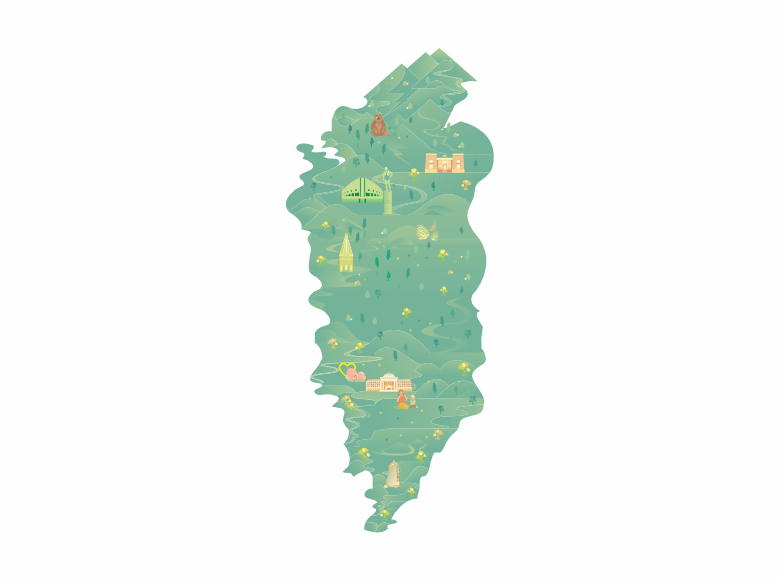
Geography. The region is located in Asian Russia. In the north, it is washed by the Kara Sea, the Laptev Sea, and the Arctic Ocean. It includes archipelagos such as Severnaya Zemlya and Nordenskiold; islands such as Arkticheskiy Institut Islands, Sergey Kirov Islands, Komsomolkaya Pravda Islands, Sibiryakov Island, and some other smaller islands.
The area is 2,366,797 km². It borders the Republic of Yakutia and the Irkutsk Region in the east, Tuva and Khakassia in the south, the Kemerovo and Tomsk Regions, the Khanty-Mansi Autonomous Area and Yamal-Nenets Autonomous Area in the west.
One-third of the Krasnoyarsk Territory is located outside the Arctic Circle.
Climate. The climate varies from severely continental to moderately continental. It is characterized by strong air temperature fluctuations during the year.
Average temperature
- -36°C in the north and -18°C in the south in January
- +10°C and +20°C relatively in July
Population
Economy. The Krasnoyarsk Territory is one of the largest Russian manufacturers of non-ferrous metals. It is also one of the leaders in coal mining, manufacturing of grain harvesters, household refrigerators and freezers, sawn half-timbers, industrial wood, and in electric power output.
Logistics. The region’s transport system includes all kinds of transport, including pipeline transport.
- Four main highways (Р-255, Р-257, Р409, Р408)
- Automobile transport is well developed: there are more than 26 airports in the region. The international airport in Krasnoyarsk is the largest one.
- Krasnoyarsk railway station
The capital is the city of Krasnoyarsk, founded in 1628. It is the largest of the old Siberian cities and Russia’s easternmost city with a million-plus population. Its population is 1,212,581 residents.
Krasnoyarsk is a very beautiful city, a major research and education and sports center in Russia. The city has a philharmonic with an organ hall, plenty of sports facilities, and a zoo with the richest collection.